
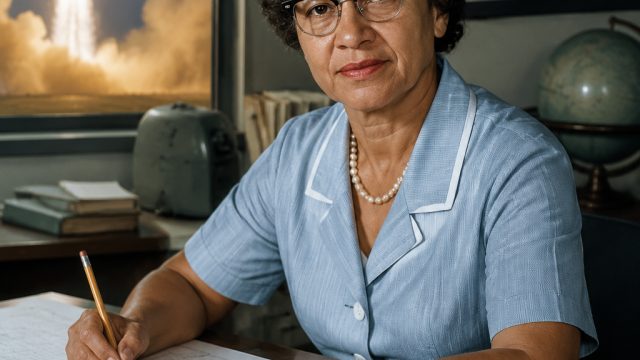
Katherine Johnson, an extraordinary mathematician, is a name that resonates deeply within the annals of aerospace history. Her contributions to NASA not only advanced the United States' space exploration efforts but also paved the way for future generations of women in STEM. Today, as we reflect on her legacy, it is essential to recognize why her story remains relevant in contemporary discussions about diversity and innovation within the fields of science and technology.
The Early Years: A Gifted Mind Unfolds
Birthed in 1918 in White Sulphur Springs, West Virginia, Katherine Johnson showed an inclination for mathematics from a young age. Against the backdrop of segregation and limited educational opportunities for African Americans, Johnson excelled academically. By age 14, she had already enrolled in high school, and she graduated from West Virginia University with degrees in Mathematics and French. This impressive academic trajectory laid the groundwork for her future contributions to NASA.
A Trailblazer at NASA
In the early 1950s, Johnson began her career at the National Advisory Committee for Aeronautics, which would eventually evolve into NASA. Her initial role was a 'human computer,' performing complex calculations by hand that were crucial to early space missions. In an era where technology was far less advanced, Johnson's precision and brilliance were instrumental in ensuring the success of missions that would change the face of space exploration.
Calculating Orbital Mechanics
One of Johnson's most notable achievements came during the Mercury program. She was tasked with calculating the trajectory for John Glenn's historic orbital flight in 1962, a mission that validated the United States' capabilities in space against the backdrop of the Cold War. Glenn famously requested that Johnson personally check the calculations done by the IBM computer, highlighting the trust he placed in her expertise. This moment was not just a breakthrough for American space travel; it was a powerful affirmation of the role women, particularly women of color, could play in fields dominated by men.
Breaking Barriers and Shaping Futures
Katherine Johnson's legacy extends beyond her mathematical prowess; her determination to break barriers inspired countless others. In a time when racial and gender discrimination was rampant, she became a beacon of hope and change. Johnson's journey reflects the ongoing struggle for equality and representation in STEM fields. Her story is a reminder of the importance of diverse perspectives in driving innovation.
The Impact on Future Generations
- Encouragement for Young Women: Johnson’s achievements serve as an inspiration for young girls aspiring to pursue careers in mathematics, engineering, and technology.
- Recognition of Diversity: Her story has spurred conversations about the necessity of diversity and inclusion in STEM, leading to initiatives aimed at fostering talent from all backgrounds.
- Educational Programs: Many organizations have since developed programs that honor Johnson’s legacy by promoting STEM education among underrepresented groups.
Conclusion: A Legacy that Soars
Katherine Johnson passed away in February 2020, but her legacy continues to inspire and influence. As we celebrate her contributions, it is crucial to recognize that her story is not just about individual achievement; it represents a collective journey toward inclusivity and recognition in the fields of science and technology. As we forge ahead in the 21st century, let her life be a guiding light, reminding us of the incredible potential that lies in diversity and the necessity of equity in STEM. Johnson's work was, and remains, a vital part of our collective history, proving that with determination and skill, the sky is not the limit but merely the beginning.
